
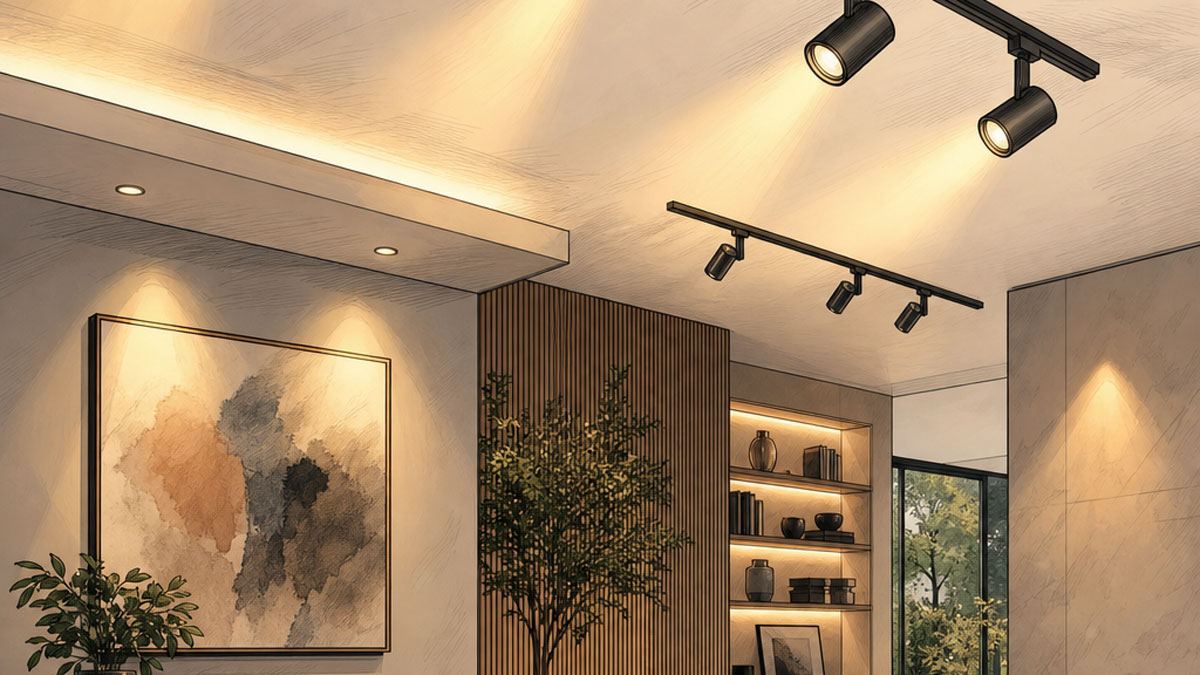
Track Luminaires
Museums, exhibition halls, and retail stores periodically change their displays. This often requires changing the layout of the lighting fixtures as well. Track lighting systems were developed to make this process quick and easy. They consist of a guide rail, called a track, and adapters that attach spotlights or luminaires to it. Some lighting fixtures are designed specifically for use in track systems and have a built-in adapter.
The track is usually mounted on the ceiling. When needed, the position of spotlights or luminaires can be changed simply by moving them along the track, without dismantling and reinstalling the equipment. In addition to supporting the lighting fixtures, the track also supplies power and, in some cases, control signals.
Advantages of LEDs
The main advantage of LEDs in track lighting systems is their much lower power consumption compared with other light sources. This makes it possible to use a lower voltage, so the track design does not need additional components to protect against accidental contact with live parts. As a result, the track can be made narrower and lower in profile. Many modern LED track lighting systems operate from a safe DC voltage of 12, 24, or 48 V.
There are track systems with a 12 V supply voltage that use halogen lamps; they also do not require protection against electric shock. However, because of the high current consumption, the track is still bulky, since it requires thicker conductors. LEDs do not have this problem.
Controlling Luminaires and Spotlights
In a traditional design, the track may include several power buses. Each bus supplies its own group of lighting fixtures. By applying power to selected buses, the corresponding groups of luminaires or spotlights can be turned on.
A more modern option is to transmit control signals using the Digital Addressable Lighting Interface (DALI) protocol over a separate pair of conductors built into the track. This approach allows each lighting fixture to be controlled individually.
Current Trends
In the past, track lighting systems were used mainly in professional applications. Today, they are increasingly used in offices and homes. As a result, two development trends have emerged.
First, track width is being reduced so the system is as unobtrusive as possible on the ceiling. Along with the use of a safe supply voltage, wireless control is used for individual lighting fixtures or fixture groups. This allows the track to have only two conductors, which are used for power.
Second, magnetic track lighting systems are becoming more widely used. In conventional track systems, fixing a fixture in a new position requires changing the position of a special lever on the adapter. Magnetic attachment of luminaires and spotlights to the track makes system maintenance easier and also allows the track height to be reduced, making it less noticeable.
These improvements are now used not only in offices and homes, but also in museums located in historic buildings. This helps present historic interiors in a more authentic way.


