
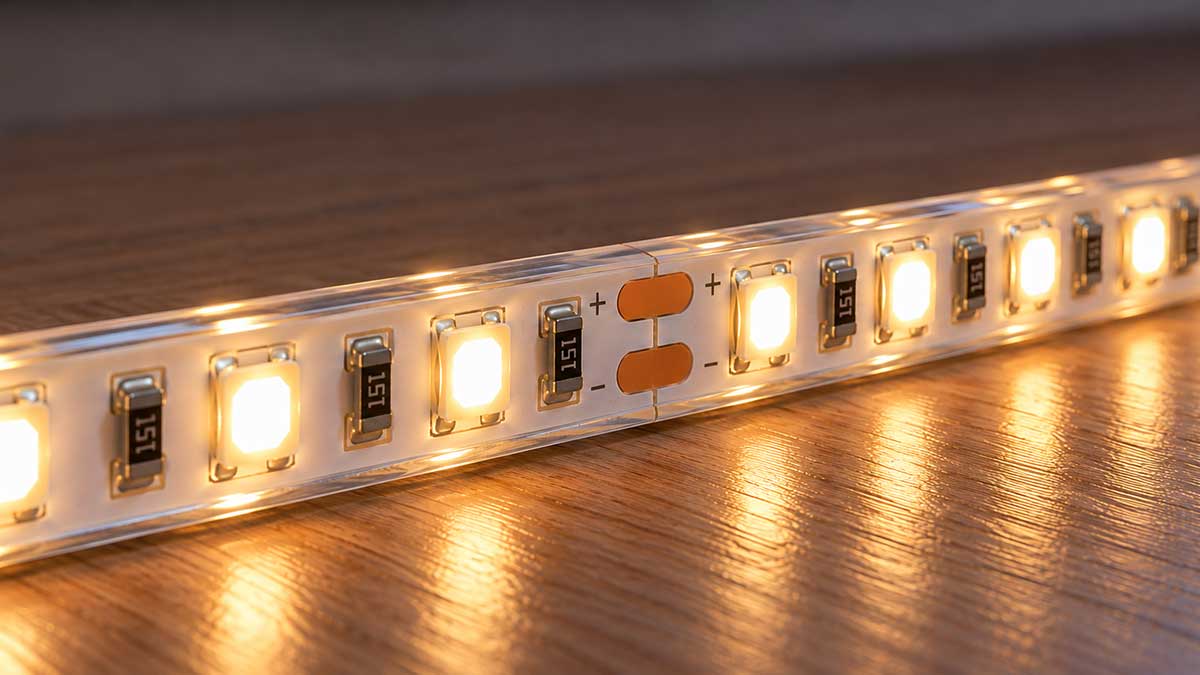
The introduction of LEDs made a new type of light source possible: the LED strip. An LED strip consists of a flexible conductive substrate with LEDs and the electronic components needed for proper operation mounted on it. Most LED strips have an adhesive backing for quick installation on a surface or inside a purpose-built aluminum profile. Some have an outer covering that protects against moisture and dust and, in some cases, shapes the light distribution.
General-purpose LED strips are typically powered by a regulated DC power supply. Supply voltages include 5, 12, 24, 36, and 48 V, with 12 and 24 V being the most common. Higher supply voltages are preferable because they reduce losses in the flexible substrate, producing more uniform brightness along the strip. However, voltages above 48 V are very rare in LED strips because they require additional protection against electric shock.
LED strips are usually sold in 5 m (16.4 ft) lengths. They can be cut, but only at the designated marks. For longer runs, sections can be joined using special connectors. The maximum length is limited and specified in the strip’s technical documentation.
“Smart” LED Strips
On most LED strips, brightness and color, where color adjustment is supported, are controlled for all LEDs at once. Some strips, however, allow individual LEDs to be controlled separately. This is usually done through DMX512 for professional applications or SPI for consumer applications. These strips have additional integrated circuits (ICs) mounted on the flexible substrate to implement the control protocol.
Some LED strips can also be controlled directly through wireless protocols. These incorporate a miniature control module with wireless connectivity at the beginning of the strip.
Neon Flex
Neon flex can create striking visual effects in interior and architectural lighting. It consists of an LED strip encased in a silicone jacket that diffuses the light from the LEDs. This creates the appearance of a continuous line of light, with no individual LEDs visible. Like neon tubes, neon flex can be used to create eye-catching signs. Signs made with neon flex, however, are easier to manufacture and more durable.
From Decorative Lighting to General Lighting
LED strips were originally developed for decorative lighting. Today, they are increasingly used for general lighting in homes and public spaces. A strip’s suitability for general lighting can be assessed by its power consumption per unit of length. For strips intended for general lighting, this should be at least 10 W/m (3 W/ft). The strip’s color rendering index (CRI) and color temperature are also important. When properly selected and installed, LED strips provide soft, comfortable lighting.
---
Technical note: The universal minimum of 10 W/m for general lighting and the claim about additional shock protection above 48 V should be verified against applicable technical guidance.


